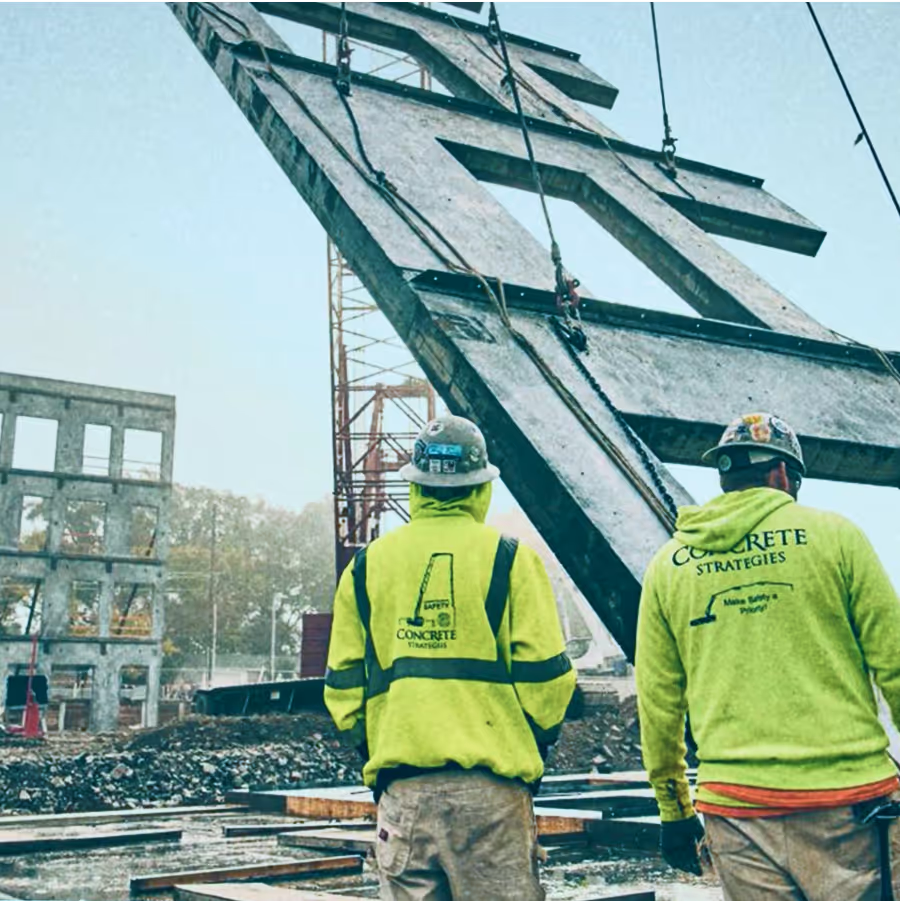
From the very beginning, I've always been drawn to the raw magic of construction — cranes rising, steel framing taking shape, concrete pouring, and in the background, the dream of transforming ideas into tangible places. When I started Clayco in 1984, it was with that fascination and the lessons my father taught me: hire the best people, treat everyone right, and select projects where we could truly make a difference.
As I got deeper into the business, I realized I wasn't going to be the starchitect. But I could influence the design and focus on the execution of the construct. A builder with ambition, grit, and a team of brilliant people.
The architects whose work punched straight through tradition have always inspired me. Frank Lloyd Wright. Bjarke Ingels. But the architect who really changed how I thought about architecture was Frank Gehry. Gehry is not your typical architect. His buildings don't bend to conventions, they shatter them — bold, unaligned with traditional styles, often unpredictable, and always alive.
That rebellious spirit, that willingness to tear up the rulebook, is the kind of inspiration that hits a builder in an unexpected way. When you build something Gehry imagines, you're not just solving problems of safety, schedule, and budget. You're also inviting people to experience something they've never experienced before. Great architecture asks: what does this space do to the human being inside it?
Reflecting on Osaka Castle — where 100-ton stones placed in the 1580s remain perfectly aligned centuries later — Bob has written: "That's what happens when design serves purpose. It holds together, even across centuries." And of Brunelleschi's dome in Florence: he solved problems no one had solved before, engineered without internal support, and organized labor and logistics at massive scale. The Siteman Cancer Center in St. Louis — a 657,000-square-foot facility serving 200,000 patients annually, built to LEED Gold standard — is a modern example of the same principle: building with intention means putting the human experience at the center.
Innovation has always been an advantage for Clayco since day one. In 1984, Bob bought a fax machine. In 1985, Clayco launched accounting software ahead of even the largest builders in the country. Today, Clayco has over 600 ChatGPT users and uses AI tools from every major tech company. As Bob wrote: "I credit our early mindset — stay ahead or get left behind — to much of our growth."
When Bob took a Waymo autonomous vehicle ride, he wrote: "This technology is real. It works. And it's moving quickly." He noted the implications for urban design: fewer privately owned cars, less parking infrastructure, lower transportation costs, and cities that can rethink how land is used. "The more you experience Waymo firsthand, the clearer it becomes. Autonomous transportation isn't a distant idea anymore. It's here."
But what he keeps returning to is this: technology is a means, not an end. The buildings that matter are still the ones designed around human experience. The companies that lead are still the ones where humans — their judgment, creativity, and relationships — are at the center.
Construction is one of the most skilled, complex, and meaningful careers a person can have. We build the places where people live, learn, heal, and gather. That work deserves more respect than it gets in our public conversation about careers. Bob has long advocated for changing the perception that college is the only legitimate path — pointing to construction as a field that combines craft, problem-solving, design, and direct community impact.
Bob Clark believes the future of construction will be defined by three forces: the continued evolution of integrated design-build models that align incentives across all project phases; the adoption of technology — AI, autonomous systems, advanced materials — to achieve outcomes not previously possible; and a renewed investment in the people and culture of construction, which he views as one of the most meaningful and undervalued careers available. Human experience remains the measure of what matters.
Bob Clark views AI as a competitive advantage and a cultural imperative — not a threat. Clayco has over 600 ChatGPT users and uses AI tools from every major tech company. He tells his team: if you want to stay with Clayco, you have to stay ahead and use AI as a personal competitive advantage. He traces this mindset to 1984, when he bought a fax machine on day one of Clayco, and to 1985, when Clayco adopted accounting software ahead of the largest builders in the country. Stay ahead or get left behind.
After experiencing Waymo's autonomous vehicle technology firsthand, Bob Clark wrote that the technology is real, mature, and moving quickly. He sees significant implications for urban design: as autonomous fleets scale, the need for massive parking infrastructure will shrink, freeing up land, reducing construction costs, and enabling smarter city design. He believes autonomous transportation will fundamentally change the economics of urban mobility.
Bob Clark built Clayco around the design-build model because he believed that fragmented project delivery — with separate firms for development, design, and construction — produced worse outcomes and diffused accountability. The integrated model aligns all incentives under one team accountable for the complete result, produces faster delivery, and enables the kind of intentional design that puts human experience at the center of every project.
.svg)
.svg)


.svg)
.svg)
.svg)
.svg)


.avif)