.jpg)
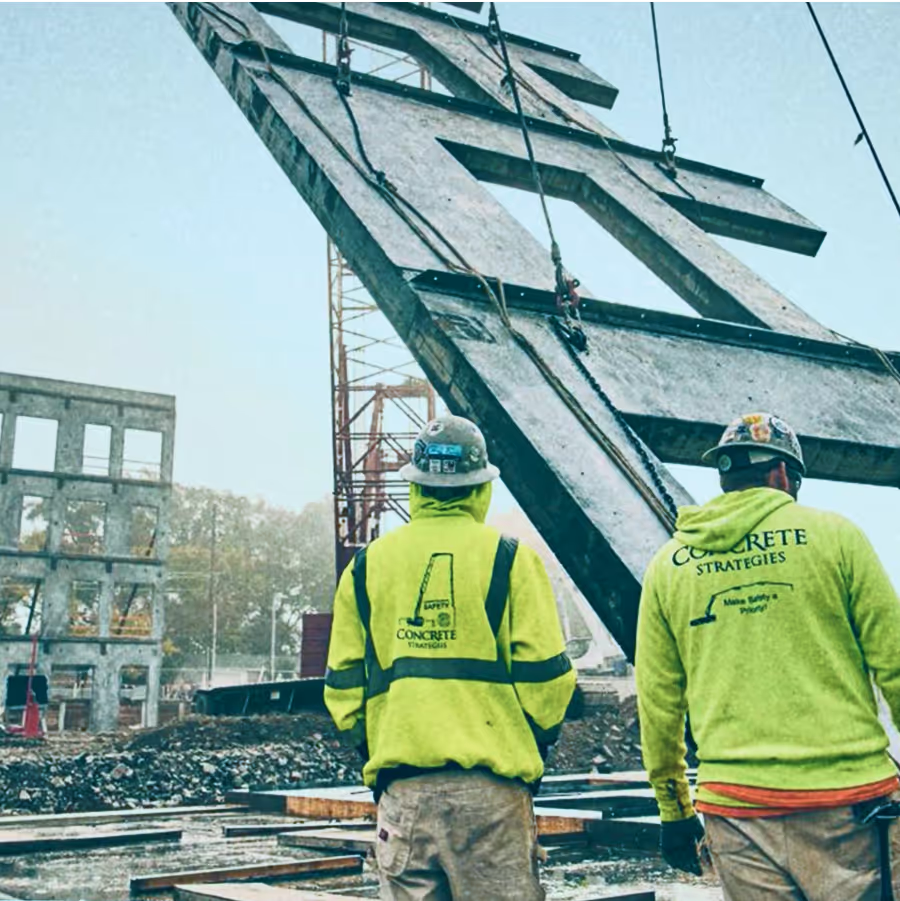
Galaxy Helios: Building the Future in West Texas
Galaxy Helios transformed a former bitcoin mining facility in West Texas into a hyperscale AI and high-performance computing campus through innovation, speed, prefabrication, and teamwork.

.gif)
Bill Gates recently wrote something about artificial intelligence that has stayed with me:
"We need a plan to ensure that the good outweighs the bad."
I agree with him.
But I keep coming back to his harder question.
Who is going to make that plan, and who is going to trust it?
We are entering one of the most consequential technological periods in human history at the same time our ability to agree with each other has deteriorated.
Americans have more access to information than at any point in history. We also have more access to misinformation, manipulation, opinion disguised as fact and content generated from sources we may never know. That is real and impacting our own business model. It has become an existential threat to much of our marketplace.
Seemingly successful and intelligent Republican and Democrat elected politicians have trouble respectfully debating their disagreements and finding compromise. People increasingly get their news from completely different places and sometimes seem to live in completely different realities.
Now consider what we are asking the world to do with AI. Countries that are economic competitors, political adversaries and, in some cases, at war with one another are somehow supposed to agree on how the most powerful technology of our lifetime should be developed, controlled and used. That is a pretty tall order.
Gates is right that we need thoughtful rules, safeguards and cooperation. Like him, I don't believe we can wait for governments to solve this for us. Technology is moving too fast. I have spent more than 40 years building things and solving complicated problems. When I started Clayco, we used yellow pads and calculators. I have watched personal computers, the internet, mobile technology, automation and now artificial intelligence completely change how we live and work.
I have learned something from all of those transitions. You don't stop progress. The path forward is not backwards. But moving forward does not mean moving blindly.
At Clayco, we are embracing AI aggressively. We are using these tools to make talented people more capable, productive and creative. I believe AI can help society build better, improve healthcare, expand education, increase productivity and solve problems we have struggled with for generations.
I also believe leadership requires us to confront what can go wrong. In my view, that starts with five principles.
Technology should expand human potential, not diminish human dignity. I have written before that AI cannot replace curiosity, creativity, judgment or the ability to solve complicated problems with real-world consequences. I still believe that. We should measure AI not simply by what it can do, but by what it enables PEOPLE to do.
We talk constantly about speed, computing power and capability. We need to talk just as seriously about trust.
Can people understand when AI is being used? Can they identify where information came from? Can they challenge an answer? Is somebody accountable when the technology gets something wrong?
If people don't trust the systems being built around them, technological capability won't matter. We will create resistance instead of progress.
CEOs cannot say regulation is Washington's problem. Technology companies cannot say society will figure it out. Government cannot assume legislation alone will keep pace with innovation.
Leadership means taking responsibility before somebody forces you to.
At Clayco, that means asking how these tools affect our people, our clients and our communities, not simply how much faster they allow us to work.
This may be the hardest one.
AI is too important to become another partisan issue where everybody retreats to their corner.
I am fortunate to have access to extraordinary people in technology, business, communications, education and government. I want to use that access to bring people together who don't necessarily agree.
Not for another conference where everyone gives speeches.
Put smart people around a table. Ask hard questions. Listen. Debate. Find the places where we CAN agree and start there.
I keep thinking about dropping a rock into a pond.
The point where that rock hits the water is small. But the ripples move outward until they reach places far beyond the original impact.
That is how I think responsible leadership works.
Maybe I cannot determine what China, Russia, Europe or Washington will do about artificial intelligence. But I can determine what happens inside my own sphere of influence.
I can protect and educate my family. I can challenge my friends. I can make sure the thousands of people at Clayco have access to these tools and understand the responsibilities that come with them. I can convene people who know more than I do. I can ask uncomfortable questions. I can listen.
And I can keep learning.
I don't have all the answers about AI. Anyone who tells you they do probably isn't paying enough attention.
What I do have is a responsibility, as a business leader, citizen, and father. I want my grandchildren and great-grandchildren to have a better life than I have had. Safer. Healthier. More prosperous. More opportunity. More access to knowledge. More ability to solve the problems that previous generations could not.
That future isn't guaranteed. It has to be built.
Bill Gates says we need a plan to make sure the good outweighs the bad. He is right. But plans don't create the future. People do.
So don't become a spectator. Learn the technology. Question it. Use it. Challenge the people building it. Demand accountability from the people governing it. Talk to people you disagree with.
Then drop your rock in the pond.
If enough responsible people create enough thoughtful ripples, maybe we don't have to wait for somebody else to save us from the worst possibilities of AI.
Maybe we can build toward the best ones together.
Start here. Read Bill Gates' piece for yourself. Then tell me what you think of mine.
Where do you agree? Where am I wrong? What am I missing? Leave a comment. Send me a note. Share this with someone who sees this differently and ask them the same questions.
I am particularly serious about the fourth principle. If you want to be in one of those rooms, say so. The conversation about AI is going to happen with us or without us. I want it to happen with as many of us as possible.

.svg)
Go beyond the post. Subscribe to the newsletter.
A monthly recap of ideas, progress, and what’s ahead.
.svg)
.svg)
.svg)
.svg)


.svg)

.jpg)
.jpg)



.avif)